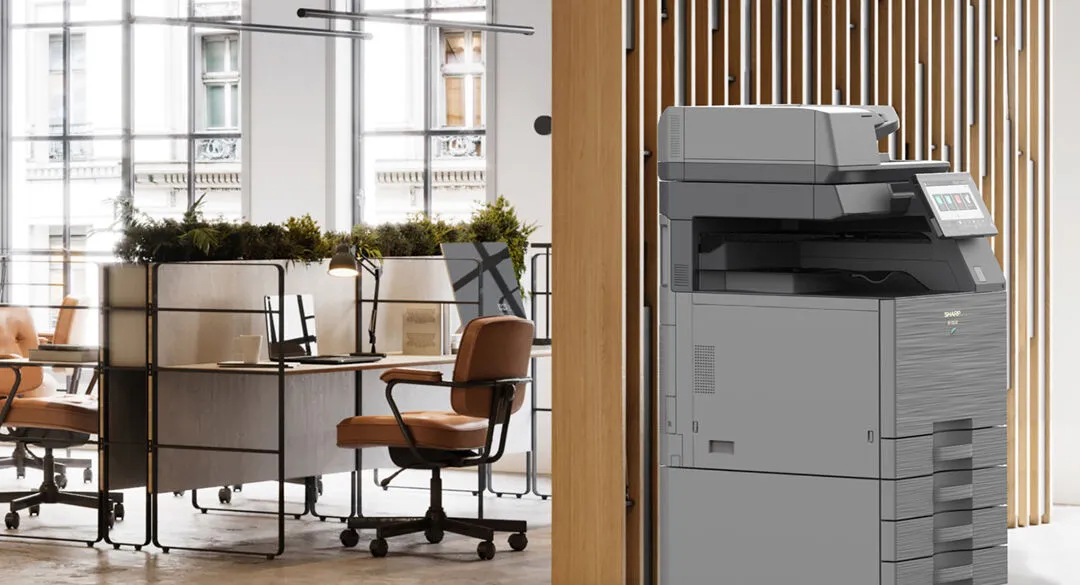

The total cost of ownership (TCO) of an office laser printer or photocopier is the monthly figure plus everything around it: consumables outside the agreement, maintenance, downtime, admin time, energy, print nobody collects, and what happens at the end of the term. For a one or two machine office, downtime and admin time are usually the two that cost the most, and neither appears on a quote.
What the quoted figure leaves out
Two offices sign near-identical contracts for near-identical machines. By the end of the term one has spent noticeably more than the other. The contracts were the same; how the machines were used and looked after was different.
A quote prices the machine and the service agreement, which is what a quote is for. It cannot price how the printer will be used or looked after. The variables inside the quote itself are covered in what a photocopier lease costs.
Cost per page, and why the purchase price is only part of it
Cost per page is the price of the toner divided by the number of pages the manufacturer rates it for, at standard coverage. Work it out separately for mono and colour, because a colour page costs several times more than a mono one. A machine that is cheap to buy can be dear to run if its toner yields are low. Under managed print services you pay a fixed cost per page instead, with toner included and dispatched before you run out.
Print volume is what turns cost per page into a monthly number. The more you print, the more the running cost outweighs the machine, and the more it matters that the printer suits your volume.
Outside the invoice
What never shows up as a line item
Paper, toner beyond the plan and the time spent chasing consumables never appear as a single line on an invoice. They build up the way the files on the shelf do. Check what is bundled against what you use before you sign.
1. Downtime
When a printer is down, the bill that matters is the people working around it: the client document that went out late, the afternoon a job waited. In a one-machine office there is nothing to work around to, so a day down is a day without printing.
This is the largest hidden cost in most small offices and the one nobody records, because it never generates an invoice. That is why average repair time is worth asking about as a number. With us, faults are fixed in hours, not days: the average repair takes 3.2 hours, and emergency response across Sydney metro is under four hours.
2. Admin time
Ordering toner, logging faults, chasing a technician, checking invoices. In a small office it usually falls to one person, often the practice manager or office manager, on top of their real job. An hour a week across the term is a real number.
It grows quietly when desktop printers creep in beside the main machine. In our published work with a Sydney medical practice, toner for 20 desktop printers was being bought as needed across three sites, so nobody knew what printing cost. One agreement and one invoice removes most of this, which is the practical case for managed print in a medical practice.

The invisible line item
When printers are bought as they break
At a Cherrybrook pharmacy we worked with, printers were bought from office supply stores as each one failed, and each lasted about a year. Their small-yield toners cost more per page, and spares for a broken model were useless for its replacement. Working out what each device really cost identified a 28 per cent reduction. That work is written up under pharmacy.
3. Consumables that sit outside the plan
What is bundled varies by agreement, and paper almost never is. Staples often are not. Under a per-page arrangement toner is typically included and dispatched automatically. Under a hardware lease with a separate service agreement, check. High-yield toner lowers the cost per page, and automatic double-sided printing can roughly halve the paper on multi-page documents.
Which of the three agreement types you are on decides most of this, and the distinction is set out in printer lease contract terms.
4. Maintenance cycles
Drums, fusers and other long-life parts wear out on a schedule measured in pages. Without a service plan those parts and the labour to fit them are a cost every time. Under a service plan they are covered, and preventative maintenance means we service it before it breaks, so quality holds and the printer keeps running between visits.
Without it, a worn part shows up first as streaks and jams, then as a service call, and in a one-machine office that call leaves the whole office waiting.
5. Energy use of a multifunction printer
Electricity is a real but modest line for one or two machines, usually well below consumables and downtime. Compare the Typical Electricity Consumption (TEC) rating on each model's specification sheet, and check the sleep mode. Canon's C3900i series, for example, uses low melting point toner to keep its TEC rating low.
6. Print that is never collected, and the security side
Jobs get sent, someone gets pulled into a meeting, and the pages sit in the tray until they are binned. That is paper, toner and machine wear spent on pages nobody read.
In a practice holding patient or client files it is also an exposure, since those pages sit where anyone can read them, and a breach costs far more than toner. Secure release printing removes most of it, because a job that is never collected is never produced. The mechanics are in office print security.
7. Several machines that no longer match
Once an office runs several machines, bought one at a time from different brands, each has its own consumables, its own service arrangement and its own quirks, and each multiplies the admin. Standardising is where the saving is at that size.
In our published work with an aged care group, 111 machines across 14 facilities came from five brands and 36 models, because each facility was deciding on its own. Moving them onto one plan with four standardised models cut their average monthly print spend by 26 per cent, around $66,000 a year. That work is written up under aged care. The best time to do it is at an upgrade, covered in upgrading a leased printer mid-contract.
8. What happens at the end
Under an operating lease or a managed agreement the machine usually goes back to the provider or the financier. If you own it outright, disposal is yours to arrange, including securely clearing any data held on the device. An owned machine is a depreciating asset with its own treatment at disposal, set out in how ATO depreciation works for office printers and copiers.
Around year three or four of a term, many offices look for a payout and a newer machine at a monthly cost close to what they already pay. We can pay out your existing contract, including one with another provider.
Where the money is
For a one or two machine office, downtime and admin time are the two that matter, and neither is visible on a quote. A contract that is a little cheaper each month, on a printer that is down twice as often, costs more. The monthly figure gets compared because it is the number on the page, and it is rarely the number that decides the total.
How to work out your own total cost of ownership
- Start with the contracted monthly figure across the full term.
- Add consumables outside it. Paper at minimum. Check toner and staples against the agreement itself.
- Estimate downtime honestly. How many times last year, how long each time, and who could not work.
- Count the admin. Roughly how many hours a month go on ordering, logging and checking invoices.
- Check maintenance and energy. Which parts the service plan covers, and the TEC rating of each machine.
- Estimate uncollected print unless you have secure release set up. Walk past the tray at four o'clock for a week and count.
- Count the machines and the models, including desktop printers. If those two numbers are far apart, that gap is where the saving is.
It will not be exact, and it will still be far closer than the monthly figure on its own. It usually reorders which quote is the cheapest. The colour ratio is worth pulling at the same time, since it moves the cost per page more than total volume does. That reasoning is in colour or monochrome.
What this looks like in Sydney
Downtime is the cost that varies most by who you are with. Buy direct from a manufacturer and you ring a call centre, somebody logs a ticket, and then you wait. A cheap plan with no service plan behind it carries no warranty and nobody accountable, and an ex-rental machine's saving disappears the first time it goes down.
With us you get the same person every time, and they already know your machines. We have run Axia from Frenchs Forest since 1996 with our own technicians, and we have over 90% customer retention. The hardware runs across the Canon range and the Sharp range, and the terms behind it sit on photocopier and printer leasing in Sydney. Most of what decides your total is settled at signing, which is why the seven questions to ask a provider are worth asking before the number is agreed.
Frequently asked questions
What is the total cost of ownership for an office laser printer?
The monthly or purchase cost across the term, plus consumables outside the agreement, maintenance parts and labour, downtime, admin time, energy, uncollected print, and disposal if you own the machine. The quoted figure is usually the largest single part but not the whole, and the rest varies far more between offices than the quote does.
How does print volume affect the TCO?
Volume turns cost per page into a monthly figure, so the more you print, the more running costs outweigh the machine itself. A printer sized well below your volume wears faster and breaks more; one sized well above it costs more than it needs to. Size it from your meter reads.
Why are maintenance cycles important for TCO?
Drums, fusers and other long-life parts wear out on a page schedule. Without a service plan each replacement is a parts and labour bill; under one, preventative maintenance covers them and keeps the printer running between visits.
Does energy consumption significantly impact the total cost?
For one or two machines it is a modest line, well below consumables and downtime. Compare the Typical Electricity Consumption (TEC) rating on each model's specification sheet and check the sleep mode settings.
What role does security play in printer TCO?
Uncollected pages cost paper and toner, and in a practice holding patient or client files they are also a privacy exposure that costs far more if something goes wrong. Secure print release removes both, because a job that is never collected is never produced.
How do I compare TCO between different brands?
Use the same period for each, usually the full term of the lease. Compare mono and colour cost per page, what the service plan covers, how long faults take to fix, and the energy rating. Brand matters less than the service behind it.
What costs are not included in a photocopier quote?
Paper almost always, staples often, and never downtime, admin time or waste. A quote prices the machine and the service agreement. The rest depends on how the machine is used and set up.
What is the biggest hidden cost of office printing?
For a small office, downtime, followed by admin time. Neither appears on an invoice. Once an office runs several machines of different brands, the mix itself becomes the next largest cost.
How much can standardising several printers save?
It depends on how mixed the machines are. One aged care group ran 111 machines across 36 models and five brands, moved to one plan with four standardised models, and cut its average monthly print spend by 26 per cent, around $66,000 a year. In a smaller office, the same idea means bringing desktop printers under the agreement that covers the main machine, so there is one set of consumables to manage.
Does a flat monthly rate cover the total cost of ownership?
It covers more of it than most arrangements, because on a plan such as our Unlimited Print Plan the device, pages, toner and service sit inside one flat monthly rate. It does not cover downtime or admin time, which no agreement does, and paper is worth checking on any quote.
How do I reduce the total cost of office printing?
Cut downtime by asking for a measured average repair time, bring desktop printers and toner buying under one agreement, set up secure release so uncollected pages are never produced, and size the machine to your real volume.
Want your real cost rather than the monthly figure?
Before we quote, we review your current devices and usage: the page counts from each machine, and your consumables invoices where you have them, so we can show what each device really costs you each month.
Get your quoteAxia Office · Unit 6, 14 Rodborough Rd, Frenchs Forest
NSW 2086
(02) 9975 0888